


Pratyaksh Agarwal
16/03/2026
Supply Constraints, Secondary Markets, and Investment Behaviour in Collectable Timepieces
In the past ten years, the hobby of collecting antiques has grown from an obscure pastime into an important part of the alternative-investment sphere. Collecting anything from ancient relics to manuscripts falls within this genre, but collecting vintage wristwatches has become one of the most popular areas. Established brands such as Rolex, Omega, and Patek Philippe have long histories that form the foundation for the viability of this field. Today, the oldest existing examples, in their original state or with the ageing process, have progressed beyond the status of a piece of jewellery. They have become an elite and increasingly respected type of investment asset class. Research conducted in the industry confirms this trend. According to the Knight Frank Wealth Report, watches have become one of the fastest-growing asset classes in the world of high-end investments.
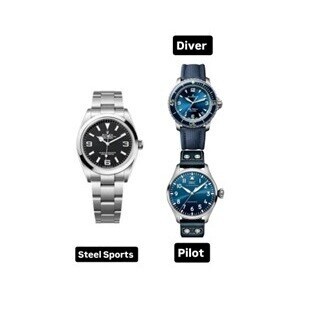
Prices for collectible watches have increased a lot over the past ten years. The Knight Frank Luxury Investment Index (KFLII) reports a 138% rise in value during this decade. The Deloitte Swiss Watch Industry Study notes that demand for pre-owned high-end watches has surged. The industry sees watches as both cultural symbols and financial tools. To navigate the vintage watch market, one must understand it as a horizontal asset class. The market divides into functional categories, such as steel sports watches, dive watches, or pilot watches, rather than being defined exclusively by brands. When an investor buys a Rolex Explorer, pictured on the left, they are not just betting on the Rolex name; they are investing in the wider "Steel Sports" category. This illustrates the idea of horizontal investing: capital spreads across a functional type that includes multiple brands. A luxury market analysis by the Boston Consulting Group highlights that category-based investment behaviour is common in collectable luxury industries. Buyers often follow trends across similar product types instead of focusing solely on individual brands.
Prices in this model often fluctuate. When the upper price limits for a specific category, like steel sports watches, become fully valued, excess capital tends to shift to adjacent categories, such as dive watches or military-style pilot watches. By monitoring the most prominent brands as market indicators, an investor can assess the health of the segment and shift capital to undervalued categories for potentially better returns. A 2023 report by McKinsey & Company observes that secondary luxury markets usually show cyclical capital flows between categories, especially when speculative demand pushes valuations upward.
With the framework of watches as a horizontal asset class established, we can explore the factors that affect price movements within the industry. The space largely operates on a structural imbalance between supply and demand. Luxury watches operate under a dual-price system: the Manufacturer’s Suggested Retail Price (MSRP), set by the brand, and the Secondary (or Grey) Market Price. While it might seem sensible to buy at MSRP, reality is shaped by significant shortages. For instance, Rolex is estimated to produce about one million watches each year, while demand is estimated to exceed ten million. This roughly 10:1 imbalance creates a persistent gap in supply. According to Morgan Stanley’s annual report on the Swiss watch industry, such supply constraints have driven the growth of the secondary watch trade.
The primary luxury watch market is clearly a strong part of the industry, with global revenues expected to hit around $50 billion in 2025. This segment is projected to grow steadily, with a Compound Annual Growth Rate (CAGR) of about 6% through 2033. This expansion is driven by a focus on quality and the rise of the ultra-high-end tier, which includes timepieces priced above $50,000.
Even with this consistent growth, the lack of highly sought-after models pushes buyers to the secondary market. There, they often pay a "liquidity premium" to skip long waitlists. The pre-owned segment has grown even faster. Deloitte estimates its current value at over $20 billion and forecasts it could reach $35 billion by 2030. Although the secondary market experienced a "great correction" after peaking in 2022, data from 2026 shows that prices for blue-chip brands have stabilized, highlighting their status as strong alternative investments.
These premiums are not fixed. Prices change in cycles influenced by shifts in buyer sentiment, social media trends, and broader economic factors. Research from Bain & Company indicates that social media exposure and celebrity endorsements increasingly impact demand in the luxury watch industry. Finding profitable opportunities in this environment means recognising emerging trends before they reach their peak. The goal is to predict which horizontal category will attract the next wave of investment as current favourites reach their valuation limits.
This dynamic opens up two main types of investment within the vintage watch market. First, there are “blue-chip” acquisitions that resemble a traditional buy-and-hold strategy. Models like the Patek Philippe Nautilus have generally increased in value over long periods, making them appealing for those with limited knowledge of the field but who want market exposure. Auction data from Phillips and Sotheby’s shows that certain Nautilus models have seen their values rise significantly over the past two decades. The second type includes speculative acquisitions. These watches often see volatile price changes in the grey market. This category may include independent watchmakers, which can offer substantial upside but also carry significant downside risk.
While watches are a relatively new aspect of alternative investments, similar investing models have existed in other collectable fields for years. A fitting comparison can be made with Lego sets. When a specific Lego set is discontinued, the supply becomes permanently capped, allowing the secondary market to set prices. Research from the Higher School of Economics found that retired Lego sets have historically produced returns similar to some traditional financial assets.
These sets tend to follow trajectories similar to discontinued watch models. For example, when the Rolex “Hulk” Submariner was discontinued, its price in the secondary market reportedly rose by about 40 per cent shortly after. Lego collectors have traditionally bought sets rumoured to be nearing discontinuation to take advantage of price spikes afterwards. The same principle applies to watches: the lower the total production, the greater the potential price increase. A further connection between Lego and watches involves how vintage items are valued. For example, a never-opened Lego set can be worth several times what a used one is. In watches, the condition, paperwork, and original box all add value to the final price, with each element adding a valuation premium. Industry auction reports suggest that watches sold with their original box and papers can fetch 20–30 per cent more than similar models lacking full documentation.
The remaining question is why watches represent such an appealing alternative investment option and which investors are drawn to them. First, it’s important to recognise that watches occupy a unique space between jewellery and financial assets. The benefit of watches is that if an investor makes the right choice, they not only own and enjoy a luxury timepiece but also may achieve a financial return. Knight Frank’s Luxury Investment Index cites this dual-use appeal as a key driver for the rising popularity of watch collecting as an investment.
This dual attraction means that the largest segment of the watch-investing demographic consists of collectors and enthusiasts. These individuals often start as admirers of fine watches and later become both collectors and investors. Another significant demographic includes investors seeking diversification. Watches can be a way to diversify a portfolio since their price movements often don’t closely follow traditional financial markets. Wealth management studies frequently mention alternative assets like watches, art, and collectables as diversification tools during times of financial uncertainty. The third major group consists of prestige-driven buyers who purchase watches mainly for social status, often without significant investment knowledge. Smaller demographics of buyers and investors share some of the characteristics discussed above.
However, it’s important to note that while the watch industry is attractive, several factors deter potential investors and buyers. Firstly, investing in luxury watches requires substantial capital. Watches subject to price fluctuations typically start at several thousand euros, which can be beyond the reach of many new investors. According to Deloitte surveys, entry prices for desirable luxury watches often exceed €5,000. Additionally, as with many asset classes today, price changes are increasingly affected by social media sentiment, one of the most unpredictable influences on premium valuations. Analysts at Bain & Company have noticed that digital communities and influencers now significantly shape luxury demand patterns. This can be intimidating for risk-averse investors who might prefer more stable traditional asset classes.
Moreover, watches are seldom considered "quick-flip" assets, with average investment horizons often estimated at five years or longer. Longer holding periods increase exposure to market volatility and opportunity costs, which may not appeal to purely financial investors. Extended investment horizons also bring added transaction and maintenance costs. Most luxury watches do not run on batteries; they rely on intricate mechanical movements made up of many precision components. Like any engine, these movements need regular servicing to keep functioning well. Industry guidelines usually recommend service intervals of three to five years, and these services can be costly, especially for complex movements. This adds risk to watch investing, as these expenses can significantly cut into potential profits.
Finally, one risk not commonly found in traditional commodity markets like gold and silver is the problem of counterfeits. Each year, the number of fakes entering the market rises, and their quality improves. Reports from the Organisation for Economic Co-operation and Development estimate that counterfeit goods make up hundreds of billions of dollars in global trade annually, with luxury goods being a major part. Without an expert eye, new investors may find it difficult to confidently enter the watch market.
It becomes clear to see that investing in watches is rife with upsides and risks, which begs the question: how has this industry performed in relation to its peers as investments? According to the KFLII, watches saw a 138-147% growth in the past 10 years, outperforming several more traditional alternative investments such as classic cars, at 118% and handbags, at 100%. The annualized return on watches reached a 9% CAGR over the last decade, clearly cementing it as one of the more consistent performers in the luxury segment. Not only do watches seem to offer a great return, the BCG reported them to outpacing even the S&P 500 between 2018-2023 by 13%. However, the one clear difference here is that these gains are likely to have been concentrated in clusters of watches or brands, rather than a single market index such as the S&P 500.
In summary, the vintage watch industry is an exciting and changing niche within the broader alternative investment landscape. However, it may not be suitable for all investors. The unique mix of risk, long investment horizons, and luxury appeal makes the watch industry one of the most distinct parts of this domain and one that deserves further exploration.
Work Cited
Bain & Company. (2023, November 20). Luxury report 2023: Converge to expand through turbulence. https://www.bain.com/insights/long-live-luxury-converge-to-expand-through-turbulence/
Bain & Company. (2025, November 20). Global luxury stays resilient despite economic headwinds and shifting consumer trends that reshape the market. https://www.bain.com/about/media-center/press-releases/2025/global-luxury-stays-resilient/
Boston Consulting Group. (2025, October). Resale’s next chapter: Luxury and fashion. https://web-assets.bcg.com/resales-next-chapter-report-oct-2025.pdf
Deloitte. (2026). Global powers of luxury 2026: Value over volume. https://www.deloitte.com/global/en/Industries/consumer/perspectives/global-powers-of-luxury.html
Deloitte Switzerland. (2023). The Deloitte Swiss watch industry study 2023: Experience over convenience. https://www.deloitte.com/ch/en/pages/consumer-business/articles/swiss-watch-industry-study.html
Deloitte Switzerland. (2025, October 8). Swiss watch industry study 2025: In-store purchases surpass online retail, pre-owned market on the rise. https://www.deloitte.com/ch/en/about/press-room/swiss-watch-industry-study-2025.html
Dobrynskaya, V., & Kishilova, J. (2022). Lego: The toy of smart investors. Research in International Business and Finance, 59, 101560. https://doi.org/10.1016/j.ribaf.2021.101560
Federation of the Swiss Watch Industry (FHS). (2026, January 29). Swiss watch exports down 1.7% to CHF 25.5 billion in 2025, uncertain outlook for 2026. https://www.fhs.swiss/
Fortune Business Insights. (2025). Luxury watch market size, share, & trends analysis report, 2026–2034. https://www.fortunebusinessinsights.com/luxury-watch-market-104410
Knight Frank. (2025). The wealth report 2025 (19th ed.). https://www.knightfrank.com/wealthreport
McKinsey & Company. (2023, November 29). The state of fashion 2024: Finding pockets of growth as uncertainty persists. https://www.mckinsey.com/industries/retail/our-insights/state-of-fashion-2024
Morgan Stanley & LuxeConsult. (2025). Swiss watch industry report 2025. (As cited in Federation of the Haute Horlogerie). https://www.hautehorlogerie.org/en/watches-and-culture/library/swiss-watch-industry-fights-back
Organisation for Economic Co-operation and Development [OECD]. (2025, May 7). Mapping global trade in fakes 2025. https://www.oecd.org/en/topics/counterfeit-and-pirated-goods.html
SkyQuest Technology Consulting. (2025). Global luxury watch market share analysis report 2025–2033. https://www.skyquestt.com/report/luxury-watch-market
WatchCharts & Morgan Stanley. (2026). 4Q25 Watch market report: Secondary market recovery and price stabilization. https://watchcharts.com/reports