

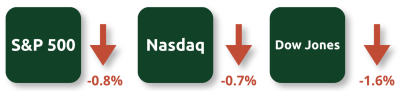
Markets hate uncertainty, and this week Wall Street got a hefty dose of it. Escalating US-Iran tensions sent oil above $100/barrel for the first time since May, reigniting inflation fears and pushing Treasury yields toward 5% on rising Fed rate-hike expectations. The Dow was hit hardest, as its heavier weighting in rate-sensitive industrial and healthcare names (UnitedHealth, Amgen, Merck) left it more exposed than the tech-driven Nasdaq or broader S&P 500.

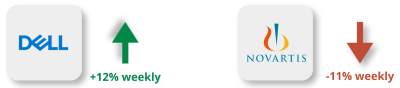
Dell Technologies (DELL) reached an all time high after RBC Capital initiated coverage at Outperform with a $640 price target, pointing to Dell's enterprise AI server backlog as the core thesis. The move was almost entirely a single day catalyst, with limited movement earlier in the week.
Novartis AG (NVS) fell after a key drug trial (del-desiran, for a muscle-wasting disease) failed to show it worked better than a placebo. This came just days after another Novartis drug (pelacarsen, for cholesterol/heart risk) also failed its trial. So the weekly drop wasn't from one bad headline, but two separate disappointing drug results hitting the stock back to back.

US Market
Against the backdrop of oil above $100 and hot CPI, Nasdaq (-0.7%) and S&P 500 (-0.8%) traded choppy for most of the week. Dell stood out, jumping to an all-time high after RBC initiated coverage at Outperform. On the downside, Adobe slipped on soft guidance the same evening as Oracle's earnings, and chip names AMD and Nvidia sold off Friday as rising yields hit growth stocks. UnitedHealth, Amgen, and Merck were the Dow's biggest drags for the week.Behind the scenes, OpenAI and Anthropic are seeking investment-grade ratings ahead of potential IPOs, allowing them to borrow more cheaply and attract pension funds and insurers as bond investors.
European Markets
With the ECB hiking rates to 2.5% and energy prices elevated, the Euro Stoxx 50 fell 1.1%. Novartis posted its worst single trading day on record (-11%) after a second failed drug trial in a week, dragging the broader pharma sector lower alongside it. Chipmakers across the region, including Infineon and ASM International, tracked the same valuation compression hitting US semiconductor names.

Tensions between Iran and the US have caused major unrest in the Middle East, leading Saudi Arabia to shut down pipelines and pushing oil prices higher. These higher energy costs are already feeding into inflation. US consumer inflation came in at 0.3%, above the expected 0.2%, while producer inflation also surprised to the upside, increasing the likelihood of further consumer price pressure. Europe is facing similar inflationary effects. In response, the European Central Bank raised interest rates from 2.25% to 2.5% last week, while markets are now also partially pricing in a potential US rate hike.
Why this matters to you? Higher interest rates make borrowing more expensive and generally put downward pressure on stock valuations, making inflation and monetary policy key factors to watch going into next week.

Oracle (ORCL): a blowout quarter may not nearly be enough
Oracle kicked off its new fiscal year with a bang: revenue jumped with 30% to $19.3 billion, driven largely by explosive growth in its cloud and AI infrastructure business, which more than doubled. Non-GAAP EPS was $1.93, beating the $1.73 estimate. Despite beating expectations on both revenue and profit, the stock still dropped around 7%, as investors grew wary of Oracle's massive spending spree to build out AI data centers.
Why is this relevant? These earnings confirm companies are keeping up their massive investments into AI infrastructure and not backing down yet. This can be a big read-through for other companies too, think companies such as ASML or Broadcom and other names further down the AI Supply chain.