



Betting on Betting
As students we’re known for our vices, a beer too many, maybe a cigarette after an Apartt drink, but one vice we shouldn’t forget is gambling. Around a quarter of all Dutch gambling accounts belong to 18 to 23 year olds. However, while our visits to the casino or TOTO often leave us poorer at the end of the day, there are companies profiting from our loss.
So if the house always wins, why not own part of the house?
The house edge
Casinos may look like they’re gambling alongside you, but they are not. They are actually selling you the opportunity to gamble, and like everything in life, that product has a price. That price is called the house edge.
Every game is built with a return to player (RTP): the share of the wagered money that flows back to players over the long run. Roulette comes in two main versions, named after the wheel rather than where it's played. European Roulette returns 97.3% on average, so its house edge is 2.7%. Blackjack, if played with a perfect basic strategy, is far friendlier at a house edge as low as 0.28%. American Roulette, with its double zero pocket, has a far higher house edge at 5.26%. Even though the game looks roughly the same as the European one, this difference nearly doubles the house edge. Whatever the number, the rule is the same: RTP below 100% means the house has a price which you pay every time you play.
A 2.7% house edge may sound like a small number, almost fair even, but it is not. The house edge is not applied to the money you deposit or trade for chips, but it is applied to every single bet you place. Say you walk in with €100 and play European Roulette. You win some rounds, lose some rounds and you keep putting your chips back on the table. By the time you are done, you may well have wagered that money 20 times over (making a total amount of bets placed €2000, also called the handle). The house did not take 2.7% of €100 but on average it took 2.7% of €2000, which is €54.
The formula the entire gambling sector runs on is defined as:
Gross gaming revenue = handle x hold
This formula is the reason behind a large part of design choices within casino equipment. A slot machine spins for 3 seconds instead of 30, making it faster to bet again. It also explains why wagering requirements are attached to bonuses and why smartphones mattered so much: putting a casino in your pocket did not just add players, it multiplied how often the existing ones could press the button. Speed is the multiplier, the edge is only the rate
It is tempting to treat the house edge as the company’s margin but one should keep in mind three other costs. First, bonuses. Free bets, deposit matches and other risk-free offers come straight off the top, turning gross gaming revenue into net gaming revenue. Second, tax. In the Netherlands, gaming tax is levied on the gross gaming result. This tax has increased sharply over the years, from 30.5% before 2025, 34.2% during 2025 and 37.8% since January 2026. More than a third of the edge belongs to the state instead of the operator. Third, marketing. In newly opened markets operators spend enormous sums of money to attract new players.
Who is "the house"?
While it’s easy to think of “the house” as a homogeneous group, this is not the case. There are a lot of ways companies can make money from gambling, and thus many investment choices for you.
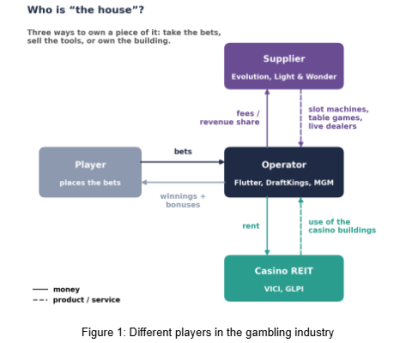
The most common gambling companies are the operators. These are the companies you directly interact with as a player, the ones happily taking your money. Think of Unibet, Flutter Entertainment (FLUT), or MGM Resorts (MGM). These companies face the most direct regulatory risks and highest marketing cost, having to fight for every gambler. They are also the most cyclical. Unless you are truly a “dedicated” player, spending on betting is often the first thing to go when times go bad.
Secondly, the suppliers are the companies that don’t directly take on the risk of a bet, they get paid regardless of who wins or loses. They provide the infrastructure, often to multiple operators at a time, essentially selling the shovels to everyone digging for gold. In this group you have, for example, Light & Wonder (LNW), which produces and sells slot machines and table games, or Evolution Gaming (Evo) which offers live dealers for online casinos.
Finally we have a casino Real Estate Investment Trust (REIT). These sit on the edge of the category, and can probably be seen as real estate investment as much as a gambling investment. These are financial instruments allowing retail investors to own a stake in the real estate behind casinos. Examples are VICI Properties (VICI) and Gaming and Leisure Properties (GLPI). Since they earn from rent and not from gambling itself, they have far more stable cash flows and are a lot less cyclically dependent.
Is business booming?
Although the house always wins, they seem to have been winning a bit more over the past few years. This mostly has to do with large scale liberalization in the sector. In 2018 the US Supreme Court struck down the federal ban on sports betting, slowly leading to a wave of expansion for companies such as DraftKings (DKNG). With the US legalizing online sports gambling state by state, newly legalized states can turn into battlegrounds. Companies trying to gain market share spend enormous amounts acquiring new customers, hoping the cost of acquisition will pay off over the long term. Quite literally, betting on betting.
Similar things can be seen in the Netherlands, where online gambling was legalized in 2021. From a technology perspective, the large-scale availability of mobile phones has also lowered the barrier to entry and caused a massive increase in betting volume. The easier you make it to lose money, the more people will lose it.
The surge of prediction markets has also created a new wave of gambling. These markets have given people the opportunity to bet on everything from elections to rate hikes. This blurs the line between investing and gambling, attracting new customers to the industry who would have never seen themselves as “gamblers”. When we look at all these points together, the industry isn’t just growing, it’s expanding into places gambling never used to exist.
So should you own the house?
If the house always wins, owning the house should mean easy money, right? The market disagrees.
With around 80 million dollars in holdings, Roundhill's Sports Betting & iGaming ETF (BETZ) is a handy proxy for the sector's performance, holding Flutter, DraftKings, Evolution and many more gambling related companies. The fund launched in June 2020, right as online betting took off. Since its inception it has returned 4.29% in total, excluding dividends. An investor who bought the S&P 500 would have made 71.7% over the same stretch of time. Over the last twelve months BETZ fell 17.7%, while the S&P 500 rose 14.3%. It roughly doubled in its first nine months, then gave almost all of it back. These first 9 months were during the gambling boom of 2020-2021, when everyone was locked at home. After the boom, there were some ups and downs, but no clear trend.
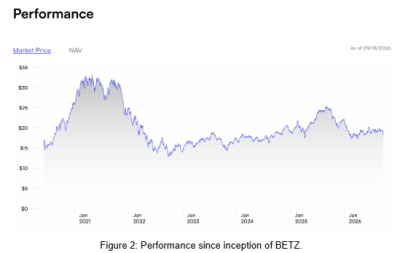
Which is strange, because the previous section was right: the industry really has been growing. Both things are true at once. The pie keeps getting bigger while the shareholders’ slice keeps getting smaller, and the three groups we met earlier each show a different way that happens.
Start with the operators. DraftKings has been a rollercoaster, with huge revenue growth but profitability arriving far later than promised. That is the marketing cost from the first section showing up in an income statement: every newly legalised state was a land grab, and the money the house won went straight back out to the next batch of players in free bets and advertising. Growing fast and making money turn out to be two very different things, and investors learned that one the expensive way.
Then the suppliers, where Evolution is the cautionary tale in the other direction. Extraordinary margins and years of earnings growth, yet the stock has been hit hard on regulatory and grey-market revenue concerns. Selling shovels protects you from losing a bet, but not from a regulator deciding the whole mine should close. A great business can still be a bad stock at the wrong price, and the market was happy to pay for perfection right up until it wasn't.
Regulators are the common thread. In the Netherlands, gross gaming result fell from €406 million in the second quarter of 2024 to €308 million a year later, after the gaming tax rose and the rules tightened. Tighter deposit limits shrank the pie, and a higher tax took a bigger slice of what was left. Which leaves the REITs, boring, steady and dividend-driven. VICI has behaved much more like a real estate holding than a gambling play, which is exactly why it is the least exciting name in this article. It is also the only one of the three that never had to win a bet or pay for a customer. Sometimes being the landlord is its own reward.
So if the house always wins, why not own part of the house? Because the house pays the tax authority, the marketing department and the regulator long before it pays the investor.