



Pay to Play: How Sport Became an Asset Class
Last month, Manchester City were reportedly found guilty of 115 charges of breaking the Premier League's financial rules. No sanction has been decided yet, but it is not the headline you want as an owner.
Yet investors have been paying up for years. Sheikh Mansour's Abu Dhabi United Group bought City in 2008 for roughly £200 million. In 2019, with the investigation already underway, an American private equity firm paid $500 million for 10% of City's parent company, valuing it at almost $5 billion. They weren’t buying a clean bill of health. Rather, they were buying revenues, a global brand and a scarce seat in the world’s richest league.
So why is so much money chasing sport in the first place? Welcome to sport as an Asset Class.
From trophy hunters to term sheets
First, who is doing the chasing? Not so long ago, owning a sports team was a hobby with a ticket office. The owner was a local tycoon, a wealthy family or, for a lucky few football clubs, a stock ticker. Ajax listed in 1998 and Manchester United followed on the NYSE in 2012 at $14 a share, inviting fans to buy a slice of the club. A lot of fans did, but a minority shareholder has no say over the transfer budget, and the share price moves with the results more than with the business. Listing gave fans a ticker, not an asset class.
Then a new era came: the trophy buyers. For sovereign wealth funds and state-linked owners, returns are only part of the story. Qatar Sports Investments bought PSG in 2011, Saudi Arabia’s Public Investment Fund took over Newcastle in 2021 and Abu Dhabi, as we saw, had already bought Manchester City. For them, a club is a billboard with a stadium attached. Wealthy families play the same game on a smaller budget: a trophy asset is rarely sold, and its owner mostly cares about which shelf it ends up on.
The owner that changed the game is private equity, and it came in through two doors. The first door is the minority stake: the investor buys less than half of a club and the owner gets fresh capital while staying in charge. The investor gets a front-row seat and a share of the upside, but no say over the squad. The second door is control: the investor buys the majority, sets the strategy, picks the management and carries the risk, hoping to sell for more later. In 2025, private equity investor Bill Chisholm agreed to buy the Boston Celtics for a then-record $6.1 billion, a franchise that had sold for $360 million in 2002.
Then there are the investors who collect clubs the way others collect stamps. Cricket shows how far that can go. Franchise owners in the Indian Premier League, the champions league of global cricket, now hold stakes in other leagues all around the world, notably South Africa, the UAE and the US. In football City Football Group holds stakes in around ten clubs across Europe, the Americas and Asia-Pacific, sharing know-how and data between them. It is the closest sport gets to a portfolio company, and it brings us back to where we started: a state owner and a private equity investor at the same table, at the same club.
Not every fund wants a club, though. The last type skips the team and buys the league, and with it the media rights. Formula 1 is the template. After buying the sport in 2006, CVC professionalised the sale of its commercial rights, signed new broadcast partners such as Sky, and opened up markets in Asia and the Americas. The calendar grew from 16 to 22 races, and the prize fund paid out to the teams grew from roughly $250 million to around $1 billion a year. Then CVC sold the sport to Liberty Media, reportedly turning a roughly $1 billion investment in 2006 into more than $6.5 billion at exit in 2017. A team sells itself to its fans. A league sells all its teams to every broadcaster at once, and that is exactly what an investor wants to own. But few investors ever get to buy the league. Instead, most buy teams or clubs, which, in Europe, comes with something a league never has: its players on a balance sheet.
Humans as assets
Ask an American investor what he owns and he will say: a franchise. Ask a European and the honest answer is: a squad. In Europe, the player is on the balance sheet: the club records his registration as an intangible asset and writes it off over the length of his contract. It does not own the person, only the right to his registration, but the result is an asset that loses value every day until the contract expires, and then walks out for free. In 2025, clubs paid a record $13.1 billion in men’s transfer fees, according to FIFA, for an asset with a mind of its own.
North America does it differently. Players are drafted rather than bought, rookies are paid on a scale, and veterans who change teams are mostly swapped for other players and picks. The asset sits in the franchise, not in the people, and its value follows the league’s media deals instead of depreciating with every contract. That is how the Celtics went from $360 million in 2002 to $6.1 billion in 2025.
Then there is the risk of falling. US leagues are closed: there is no promotion and no relegation, and the number of franchises is fixed, so a bad team still collects its TV money and an early draft pick. In Europe, no club’s spot is guaranteed: a bad team falls, and the squad on the books falls with it. Think of promotion as a call option and relegation as a put, with the owner short the put: the Championship play-off final is reportedly worth at least $275 million to the winner, and even a 20th-placed Premier League club receives about $165 million a year from the league.
Ownership follows the same split. Germany’s 50+1 rule means members hold the majority of the votes, so no investor can take control, while in the US it is the league that sets the limit: an NFL fund gets 10% at most, as a silent partner. So who owns the human asset? In Europe, a club owns a right that shrinks every year, attached to a player who can leave. In the US, the franchise owns the cash flows. One asset appreciates by default. The other has to be rebuilt every summer.
The Alpha in the stadium
But what makes institutional investors take the bait and invest billions in sports assets? Simple: sports zig while the market zags.
From a financial perspective, sports assets have delivered higher annualized total returns than key indices like the MSCI World and S&P 500 between 2007 - 2024, all while having a -0.01 correlation with global equities. The Arctos-Michigan Ross index and research from Ares Management point the same way, and show that US sports franchise value earned an excess return of roughly 2.5 and more than 4 percentage points over the S&P 500 and MSCI World indices, respectively. Why? Long-term media rights contracts, sponsorships and loyal fans. For portfolio managers, that is like the unicorn of investing. Adding this to your portfolio can make it less volatile, ultimately lifting your portfolio’s Sharpe ratio (return per unit of risk). Congratulations, you have just realized the alpha your professor always told you doesn’t exist.
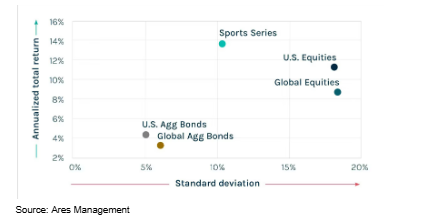
Unfortunately, we must add some nuance. Sports franchises rarely trade, so their prices more closely resemble appraisals than market values, likely explaining part of that low correlation.
What makes sports assets like ATMs is that sports teams experience a multitude of income streams. The main stream of income: Media rights. For instance, the NBA signed an 11-year media rights contract in 2024 totaling $76 billion, almost $7 billion per annum, which the league shares with its clubs through revenue sharing agreements. And the pie keeps growing, because live sport is something streamers cannot get enough of. Just look at Formula 1. Netflix's Drive to Survive helped put the sport even more on the global map, and with new fans came new viewers and bigger streaming rights deals. And the playbook is travelling. In 2026, Japanese investment firm NSSK took over commercial operations of Japan’s men’s golf tour, including media and streaming rights, and is aiming to create social and documentary content with streamers like Netflix in mind. Add to that income from ticket sales, skyboxes, merchandising and licensing, sponsorships, stadium naming rights and more, and sports assets start to sound like a pretty attractive, diversified investment.
The final ingredient is scarcity. The NFL, for instance, hasn’t added a team since 2002, while the NBA has experienced the same 30-club limit since 2004. Fixed supply, growing demand, and deal-hungry investment funds push prices up. Cricket’s Indian Premier League (IPL) shows how far. With only ten franchises, the Rajasthan Royals reportedly agreed to be sold in 2026 for roughly $1.6 billion, about six times the franchise’s value only 5 years prior, while Blackstone recently joined a consortium acquiring another franchise for roughly $1.78 billion
Scarce supply, contracted media money and a queue of buyers with fresh capital. That sounds like an incredibly attractive investment case. There is, unfortunately, one factor that can’t quite be captured in a DCF: the fans.
Fans don’t care about the PE investment case
What makes sports so valuable is that people care about it irrationally. Let’s take a closer look at football. In April 2021, twelve of Europe’s biggest clubs announced a European Super League in which the founders were guaranteed a place every year, whatever happened domestically, in an attempt to bring the American no relegation model to Europe. It lasted about 48 hours before clubs pulled out after protests from fans, players and politicians. Germany learned the same lesson in 2024, when the league planned to sell up to 8% of a media-rights subsidiary to private equity for €1 billion. They were faced with weeks of protests, and supporters hurling tennis balls onto the pitch and halting matches, eventually forcing the league to back down. American fans might not have much to say, but in Europe, fans hold a veto, and any investor not taking that into account is holding on to a broken value creation plan.
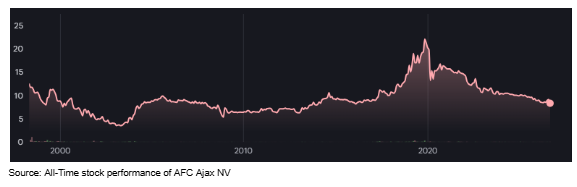
But investors must also account for sporting risk, as a club’s value follows its results. Perhaps the clearest example of this occurred in the 2018-2019 Champions League season when Ajax, the only publicly listed Dutch football club, reached the semi-finals after years of mediocre European performances, and the share price almost doubled, reflecting the club’s strong performance on the pitch. Then came the semi-final’s second leg against Tottenham. Ajax lost 3-2, and the next morning shares traded 21% lower. Ajax shareholders got a free lesson in risk management, courtesy of Tottenham. Their share price shows what the appraisals of private franchises smooth over: a market price reacts to every important loss. A loss in the semi-finals was the mild version. The real downside in Europe is relegation, a risk not carried by closed US leagues.
Emotions aside, sports assets come with strings attached and PE funds feel them first. One of them is illiquidity: you cannot sell a franchise or sports club like a stock. Most of the value is only realised when the team is sold, which is rare, and exits can take up to ten years. Leagues also add some rules of their own. For instance, the NFL requires funds to hold minority stakes in sport franchises for at least six years, and now that the average PE holding time is around seven years, that leaves little room for delay. That clock is the J-curve in action: fees and costs are paid from day one while the stake sits on the books at cost. Because of it, the early years look ugly on paper, while the payoffs arrive at the exit if at all. And let those exits be exactly what PE is struggling with right now.
But before you can enjoy either the cash flows, or the squad, as assets, you have to overcome a slight problem: the price of entry. With only a few teams on sale, auctions are won by the highest bidder, and franchise prices follow the wealth of prospective buyers, not just the team’s own cash flows. A phenomenon dubbed the winner’s curse. The attractive returns shown above might have gone to owners who bought their sports assets years ago, those buying today might come home empty handed.
The final whistle: questions to ask yourself
Back to Manchester City. A club charged with 115 breaches of the rules still had investors queuing up. For them, sport is no longer a hobby but a line in a portfolio, and on paper a very attractive one. The question is not whether the money will keep coming, but whether you should follow it. As investors, there are a few things worth asking yourself first.
Start with the most basic question: am I paying for returns, or for emotion? In other words, am I paid for the risk I take, or for the love of the game? Many owners in this article pay a premium for something a spreadsheet cannot price. If the returns disappeared but the team kept winning, would you still want in? Next, can you live with illiquidity? You cannot sell a club on a bad Monday, so your horizon has to be as long as the owner’s. And who really holds the power? In Europe it is not always the shareholder: fans can veto a business plan, and that is a risk no model captures. Finally, is this a hype, or is it here to stay? Cricket and golf have already followed football and basketball, so will other sports follow too? When every investor believes the same story, the trade gets crowded, and it is worth asking who was there first.
Sport will not stop being emotional, and that is exactly what makes it valuable. After all, there is only one Manchester City. Whether you buy it with your head or with your heart is up to you.